
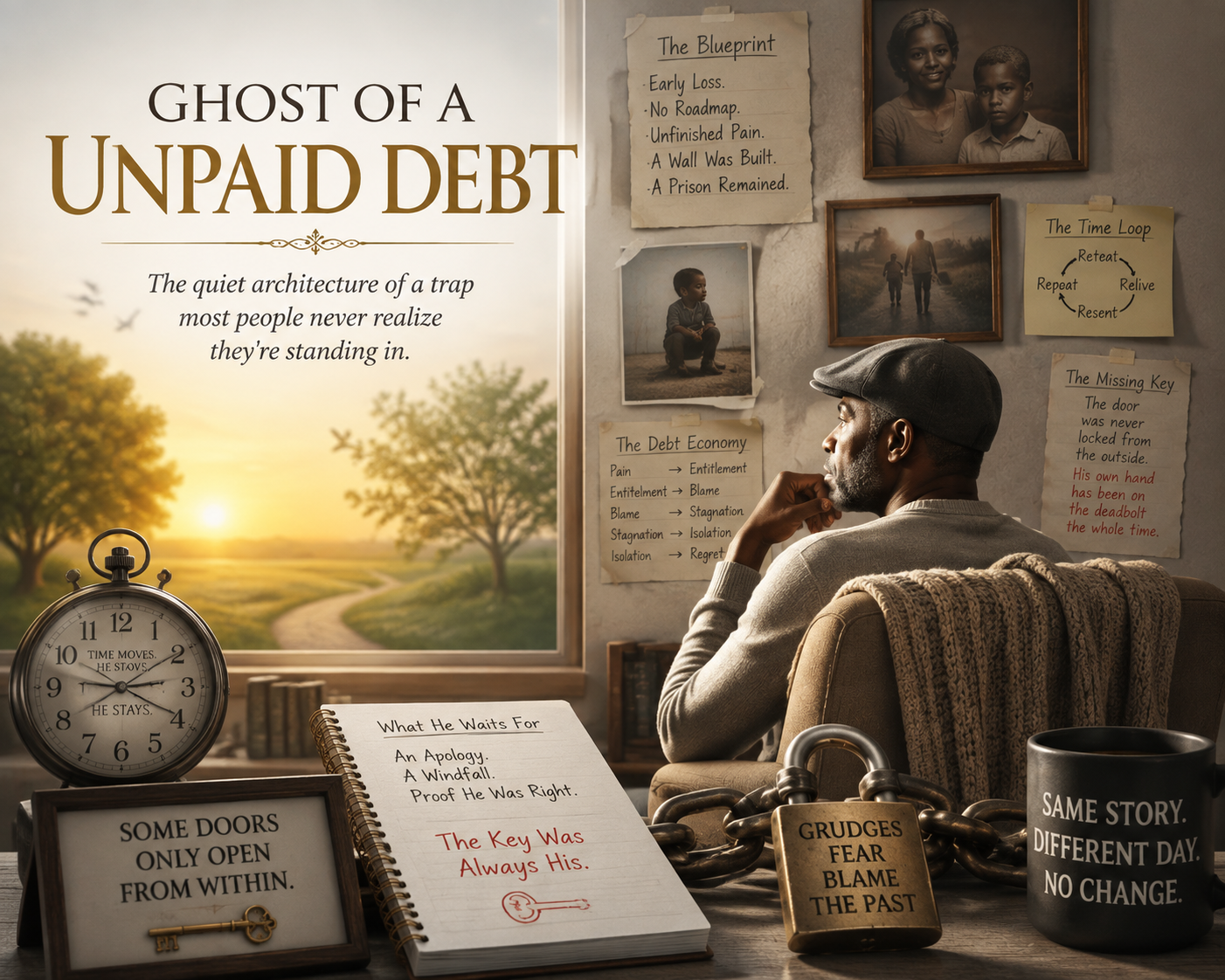
The quiet architecture of a trap most people never realize they're standing in.
To help you relate to this, and grow from it, we have to look past the anger on the surface. We have to study what's underneath it, the mechanics that hold the whole thing together.
It starts with a blueprint drawn in childhood. The early loss of a mother's love. A father who had no roadmap for his own grief, let alone a child's. That created a deficit that never fully closes. To a child, a world that can take a mother away feels unsafe. It feels unfair. So he built a defense, sixty years ago, to protect a heart that had already broken once. What he could not have known then is that the same wall built to keep pain out would become the room he could no longer leave.
From that deficit comes an economy all its own. Call it the economy of the debt. He believes, without ever saying it out loud, that life owes him a balance. Because he suffered early, some part of him is still waiting for a payout that never comes. And when it doesn't come, that disappointment has to go somewhere. So it becomes blame. Blame is a sedative. It's addictive because it removes the weight of personal responsibility. If everything is a conspiracy against him, he never has to face the harder truth. That somewhere along the way, he chose to keep standing still.
That's what drives the third pattern. The time travel loop. Challenge him, even gently, and watch him retreat further into the past instead of moving forward into the present. This isn't an accident. The present asks for change. It asks for vulnerability and accountability, and all three threaten the only identity he's held onto for decades. The past, even a painful one, is safe because it's finished. He already knows how the story ends. He knows the script by heart, and there's a strange comfort in reciting lines you've said a thousand times before.
And that brings us to the deepest irony of all. The tragedy of the missing key. He waits, sometimes for years, for the world to hand him permission to heal. An apology. A windfall. Some proof from outside himself that he was right to wait. What he doesn't see, what he may never let himself see, is that the door was never locked from the outside. His own hand has been on the deadbolt the whole time.
There is a heavy silence that belongs entirely to a man who has decided the world is his debtor. You can see it in the way he sits, turned slightly away from the window, as if the present day is an uninvited guest he refuses to welcome.
We look at him and see sixty years of stagnation. But in his own mind, he is still that young boy standing in the wreckage of a house that lost its anchor. When a mother vanishes early and a father is left to navigate the wreckage without a map, the compass breaks. For some, a broken compass becomes the reason they build their own road. For Steve, it became a permanent license to stand still. He demanded that the road build itself around him instead.
To survive the unfairness of his youth, he made a contract with his own grief. He decided that life owed him a bounty for his pain. But time is an indifferent merchant. It doesn't hand out refunds for hard beginnings. When the world failed to pay up, the disappointment curdled into something closer to conspiracy. It is easier to believe the world is plotting against you than to admit the world simply moved on without you.
Now his conversation is a museum of old grievances. Try to pull him into the sunlight of today, and he will drag you down into the dark basement of a decade you weren't even alive to see. He retreats into the past because there, at least, he is the tragic hero of his own story. The few who still knock on his door are running out of breath. You cannot hand a lifeline to a man who uses the rope to tie himself tighter to the anchor.
The deepest tragedy here isn't the anger. It isn't even the isolation. It's the realization that the prison he's built has no guards, no bars, and no locks on the outside. He is sitting in the dark, holding the very key he swears the world stole from him. He built a fortress out of his grudges, forgetting that a fortress meant to keep the world out eventually becomes the tomb that keeps the spirit in.